Thursday, 5 December 2013


 WHAT THEY SAY ABOUT MOHAMMAD


IF greatness of purpose, smallness of means, and astounding
Results are the three criteria of human genius, who could dare to compare any great man in modem history with Muhammad?


The most famous men created arms, laws and empires only. They founded, if anything at all, no more than material powers which often crumbled away before their eyes. This man moved not only armies, legislation, empires, peoples and dynasties, but millions of men in one-third of the then-inhabited world; and more than that he moved the altars, the gods, the religions, the ideas, the beliefs and souls.... His forbearance in victory, his ambition which was entirely devoted to one idea and in no manner striving for an empire, his endless prayers, his mystic conversations with God, his death and his triumph after death- all these attest not to an imposture but to a firm conviction which gave him the power to restore a dogma. This dogma was twofold: the unity of God and the immateriality of God; the former telling what God is, the latter telling what God is not; the one overthrowing false gods with the sword, the other starting an idea with the words.

Philosopher, orator, apostle, legislator, warrior, conqueror of ideas, restorer of rational dogmas, of a cult without images; the founder of twenty terrestrial empires and of one spiritual empire, that is Muhammad.
                     
As regards all standards by which human greatness may be measured, we may well ask, is there any man greater than he?
- LAMARTINE


I
t is not the propagation but the permanency of his religion that deserves our wonder; the same pure and perfect impression  which he engraved at Mecca and Medina is preserved, after the revolutions of twelve centuries by the Indian, the African and the Turkish proselytes of the Koran...The Mahometans have uniformly withstood the temptation of reducing the object of their faith and devotion to a level with the senses and imagination of man.

I believe in One God and Mahomet is the Apostle of God' is the simple and invariable profession of Islam. The intellectual image of the Deity has never been degraded by any visible idol; the honors of the prophet have never transgressed the measure of human virtue; and his living precepts have restrained the gratitude of his disciples within the bounds of reason and religion.
       - Edward Gibbon and Simon Ocklay


H
e was Caesar and Pope in one; but he was Pope without Pope's pretensions, Caesar without the legions of Caesar: without a standing army, without a bodyguard, without a palace, without fixed revenue. If ever any man had the right to say that he ruled by the right divine, it was Mohammad, for he had all the power without its instruments and without its supports.
- Bosworth Smith


M
y choice of Muhammad to lead the list of the world's most influential persons may surprise some readers and may be questioned by others, but he was the only man in history who was supremely successful on both the religious and secular level.

-Michael H. Hart

"I
f any religion had the chance of ruling over England, nay Europe within the next hundred years, it could be Islam."

"I have always held the religion of Muhammad in high estimation because of its wonderful vitality. It is the only religion which appears to me to possess that assimilating capacity to the changing phase of existence which can make itself appeal to every age. I have studied him - the wonderful man and in my opinion far from being an anti-Christ, he must be called the Savior of Humanity."

"I believe that if a man like him were to assume the dictatorship of the modern world he would succeed in solving its problems in a way that would bring it the much needed peace and happiness: I have prophesied about the faith of Muhammad that it would be acceptable to the Europe of tomorrow as it is beginning to be acceptable to the Europe of today."
-Sir George Bernard Shaw

Works Cited

  • HISTOIRE DE LA TURQUIE, PANS 1854, VOL. 11, PP. 276-77.z
  • History of the Saracen Empire, London 1870, p54.
  • Mohammad and Mohammadanism, London 1874, p 92
  • The 100: A Ranking of the Most Influential Persons in History, New York: Hart Publishing Company Inc. 1978, p 33.
  • 'The Genuine Islam,' Vol. 1, No. 8, 1936.

Tuesday, 16 July 2013

MUTATIONS
Change in the amount,content or organization of genetic material is called a mutation.  

TYPES OF MUTATIONS:

a)  POINT MUTATIONS (SINGLE BASE SUBSTITUTION): 

It is a type of small scale GENE MUTATION that causes the replacement of a single base nucleotide with another nucleotide of the genetic material, DNA or RNA.


They maybe:

  • Transitions: replacement of a purine base with another purine or replacement of a pyrimidine with another pyrimidine.
  • Transversions: replacement of a purine with a pyrimidine or vice versa.


Functional categorization:
1- Missense mutation: which results in a protein in which one amino acid is substituted for another due to base substitution.

2- Nonsense mutation: in which a stop codon replaces an amino acid codon, leading to premature termination of translation.

3- Frameshift mutation: which causes a change in the reading frame due to indels (insertions or deletions) of a number of nucleotides that is not evenly divisible by three from a DNA sequence, leading to introduction of unrelated amino acids into the protein, generally followed by a stop codon.


b)  CHROMOSOMAL MUTATIONS:
Chromosomal abnormalities involve alterations in large segments of DNA.

  • Inversions: occurs when a break is rejoined to the correct chromosome but in an incorrect orientation.
  • Interstitial deletions: an intra-chromosomal deletion that removes a segment of DNA from a single chromosome, thereby apposing previously distant genes
  • Translocations: interchange of genetic parts from nonhomologous chromosomes.
  • Insertions: when a segment from one chromosome is inserted into another chromosome.

Functional Categorization:


  • Loss-of-function mutations are the result of gene product having less or no function. 
  • Gain-of-function mutations change the gene product such that it gains a new and abnormal function
  • Dominant negative mutations have an altered gene product that acts antagonistically to the wild-type allele. 

(IF A GENE REQUIRES ONLY ONE PERFECT ALLELE TO WORK AND THAT GENE IS HETEROZYGOUS OR PART MUTANT BUT THE DEFECTIVE PRODUCT OF ONE ALLELE ANTAGONIZES THE PRODUCT OF THE NORMAL THEN ITS CALLED NEGATIVE........)

  • Lethal mutations are mutations that lead to the death of the organisms which carry the mutations.
  • A back mutation or reversion is a point mutation that restores the original sequence and hence the original phenotype.
  • Recessive mutations lead to a loss of function, which is masked if a normal copy of the gene is present. For the mutant phenotype to occur, both alleles must carry the mutation.
  • Dominant mutations lead to a mutant phenotype in the presence of a normal copy of the gene. The phenotypes associated with dominant mutations may represent either a loss or a gain of function.)


The one gene-one enzyme hypothesis
(one gene one polypeptide synthesis is a better name since genes do not always code for enzymes but also structural proteins such as keratin of hair and collagen in our skin)
It is the idea that genes act through the production of enzymes, with each gene responsible for producing a single enzyme that in turn affects a single step in a metabolic pathway.


BEEDLE AND TATUM chose the fungus NEUROSPORA for their experiments.
Neurospora crassa had several advantages:

  1.  it required a simple growth medium,
  2.  it grew quickly,
  3.  because of the production of ascospores during reproduction it was easy to isolate genetic mutants for analysis. 

EXPOSURE AND IDENTIFICATION OF MUTANT STRAINS:
They produced mutations by exposing the fungus to X-rays and then identified strains that had metabolic defects by growing them in minimal medium.

They had created single gene mutations that incapacitated specific enzymes and the mutant strains could be grown by adding the necessary and (formerly non-essential) nutrient to the minimal medium.

ARGININE DEFICIENCY:

In some cases it was the amino acid, Arginine which had to be added in order for the spores to grow.
Arginine is produced by Neurospora in a metabolic pathway controlled by enzymes where the product of one reaction serves as the substrate or precursor for the next.

ACETYLCHOLINE----ORNITHINE----CITRULINE----ARGINOSUCCININE-----ARGININE
                           
The following are the three mutant strains that are blocked at some stage in the above metabolic pathway.


  • MUTANT 1:would grow if Ornithine,Citruline or Arginine were added to it showing that the enzyme that produced Ornithine was missing.
  • MUTANT 2:would grow if C or A were added showing that the pathway was blocked due to enzyme B that produced Citruline.
  • MUTANT 3:would grow if A was added to the minimal medium thus in this case enzyme D was absent and could not contribute to the formation of A.

 CONCLUSION:
They concluded that the irradiation had altered the genes in such a way that one precursor could not convert into another.
Since the addition of one enzyme seemed to be required for the production of Arginine in each mutant Beedle and Tatum argued that the each gene was producing an enzyme.
INTRODUCTION:
It was invented by the German physicist Hans Geiger (co-discoverer of the atom nucleus) and later improved by his student Walther Muller, therefore the name Geiger-Muller counter.

GEIGER MULLER COUNTER:
A Geiger counter is an avalanche detector and is used to measure and detect forms of ionizing radiation (which includes alpha α particles, beta β particles and gamma γ rays)

PRINCIPLE:
It relys on runaway multiplication of electrons.

CONSTRUCTION:
Geiger-Muller tube, is basically a chamber filled with low pressure gas(inert gas or a mix of organic vapor and halogens.)The tube contains two electrodes, the anode and the cathode, which are usually coated with graphite. The anode is represented by a wire in the center of the cylindrical chamber while the cathode forms the lateral area. One end of the cylinder, through which the radiation enters the chamber, is sealed by a mica window.
A potential difference of +1,000 volts relative to the tube is maintained between the electrodes, therefore creating a strong electric field near the wire.


WORKING:
  • Ionization in the gas is caused by the entry of photon or a particular radiation coming through the mica window. 
  • The positively charged ions are attracted to their appropriate electrode (i.e. cation to cathode, anion to anode) and they gain sufficient energy to eject electrons from the gas atoms as they pass through the gas. This causes more atoms to ionize. 
  • Therefore electrons are produced continuously by this process and rapid gas multiplication takes place.
  • The effect of "gas multiplication" is that more than one million electrons are collected by the central electrode for every ion produced in the primary absorption process.When this happens an electrical current is established between the two electrodes.


This current can then be easily collected, amplified and measured or counted and played in the form of an acoustic signal made out of clicks each of which should correspond to the detection of a single ion.

Therefore a Geiger counter is able to detect low-energy radiation because even one ionized particle produces a full pulse on the central wire.

Monday, 15 July 2013

REGENERATION:
Regeneration is the process of renewal, restoration, and growth of lost body parts.

ABILITY OF REGENERATION:
Depends on :

  • Differentiation and Complexity
The more complex an organism the more will its cells be differentiated and lesser the power of regeneration.

PROCESS:

Some organisms are capable of dedifferentiation, in which specialized cells become more basic.
This process is involved in the regeneration of limbs in animals which are capable of this feat, with the basic cells differentiating again to construct the needed tissues, bones, and other types of cells for the replacement.

A small molecule dubbed reversine, has been discovered that has proven to induce dedifferentiation in myotubes. These dedifferentiated cells could then redifferentiate into osteoblasts and adipocytes.
EXAMPLES:
SPONGES:small parts can regenerate whole colonies.
HYDRA OR STARFISH:chopped parts can form new animal.
ARTHROPODS:can regenerate lost appendages.
SALAMANDERS AND LIZARDS:can regenerate lost tails.
BIRDS AND MAMMALS:new cells can form at points of wounds.

CELL DIFFERENTIATION AND STEM CELLS:

The process during which young, immature (unspecialized) cells take on individual characteristics and reach their mature (specialized) form and function.

EXAMPLES:
Embryonic stem cells Fetal stem cells Cord blood stem cells and some adult stem cells are capable of performing this process.

Totipotent : Toti, meaning total, the zygote and the embryo during early stages of development have the potential to become any type of cell and can produce a whole human being.

Pluripotent: Cells which can differentiate into several different cell types,except placenta, are considered to be pluripotent

EMBRYONIC STEM CELLS:
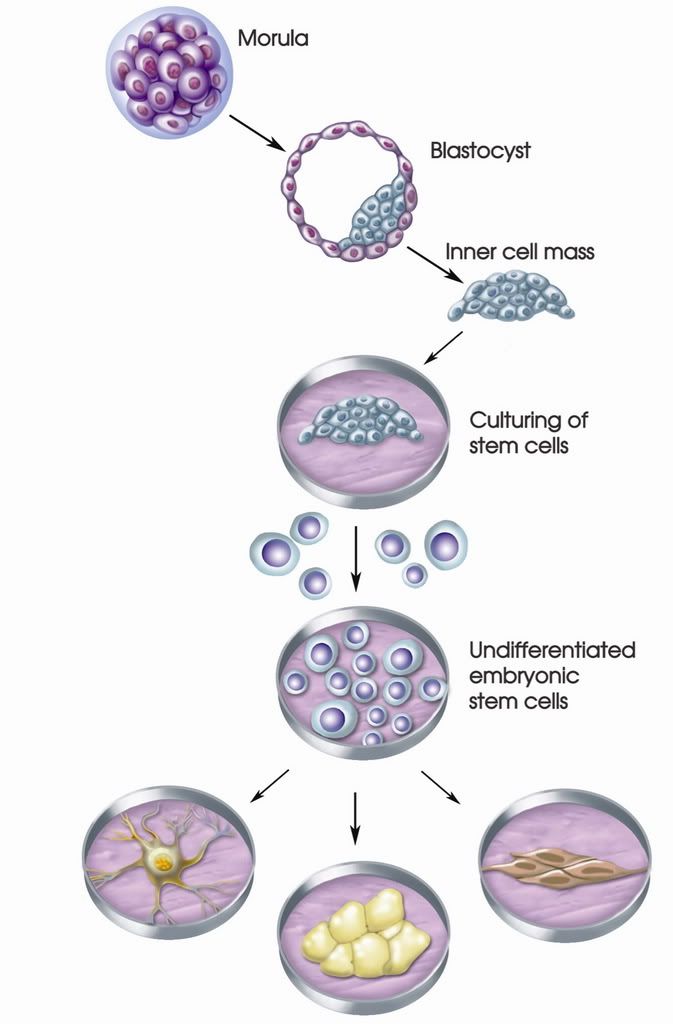
Cells that form the inner mass of a blastocyst during embryological phase of growth (lasting 8 weeks)are called embryonic stem cells.Like all stem cells they can proliferate and give rise to specialized cells.

CULTURE OF EMBRYONIC STEM CELLS
Credit: The National Academy of Sciences has kindly allowed the images to be reprinted on the weird science blog. Check out the original link called Understanding Stem Cells, courtesy of the National Academies Press in Washington, D.C.
FETAL STEM CELLS:
The cells taken from a fetus (after 8 weeks of development an embryo is termed as such) are called fetal stem cells.

ADULT STEM CELLS:
These are undifferentiated cells found throughout the body that are involved in refurbishing the body with new cells to replace worn out ones.
Examples of stem cells in an adult:
Hematopoietic stem cells
Neural stem cells
intestinal stem cells

CORD BLOOD STEM CELLS:

The cells of the umbilical cord and placenta are unspecialized stem cells and can be cultured.

CAUSE:
Specific groups of genes are expressed in each cell type which leads to production of specific proteins (the other unneeded genes are turned off)
Proteins (coded for by the DNA) are the keys to differentiation in animal cells

The particular combination of genes that are turned on (expressed) or turned off (repressed) dictates cellular morphology (shape) and function. This process of gene expression is regulated by cues from both within and outside cells and lead to differentiation.

CHEMICAL COMPOSITION OF CHROMOSOMES:

The major chemical components of chromosomes are DNA, RNA, histone proteins and non-histone proteins. Calcium is also present in addition to these constituents.

DNA -Deoxyribonucleic Acid:
DNA is the most important of chemical components of chromatin, since it plays the central role of controlling heredity.

Histone proteins:
These are Lysine And Arginine rich, basic and stable proteins in chromosomes.
They are classified into five types called HI, H2A, H2B, H3 and H4. 

Non-histone proteins:
Non-histone proteins provide the scaffolding structure.

DNA PACKAGING:

The diploid human genome contains 6 billion base pairs of DNA per cell.This is enough to make some very lengthy journeys like, to the sun and back.300 times.In order for this massive amount of DNA to exist in a cell ,it has to be made very compact.In short, it needs to be packaged into a very small surface area to volume ratio.
Patterns of packaging are facilitated by associated proteins, which in eukaryotes, could be histones or non-histones.

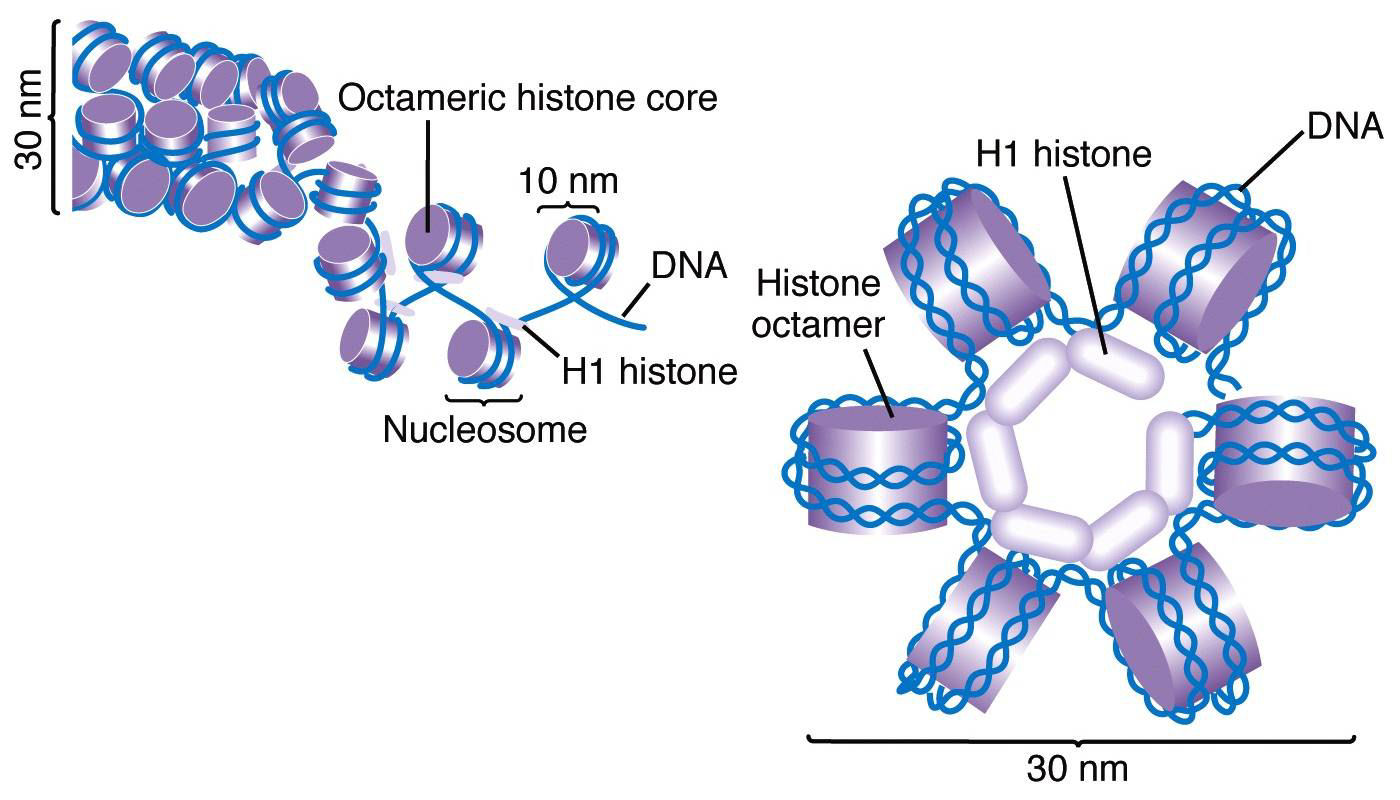
The unit of compaction is nucleosome consisting of a segment of DNA wound in sequence around four histone protein cores.


  • Histone proteins provide the spools about which DNA winds thus compressing 1.8 meters of dna into 90 mm.The negatively charged coil of polynucleotide (due to phosphate) is strongly attracted by the positively charged histone protein which helps in compaction.

  • The nucleosomes are linked together by the long strand of DNA called linker DNA. 
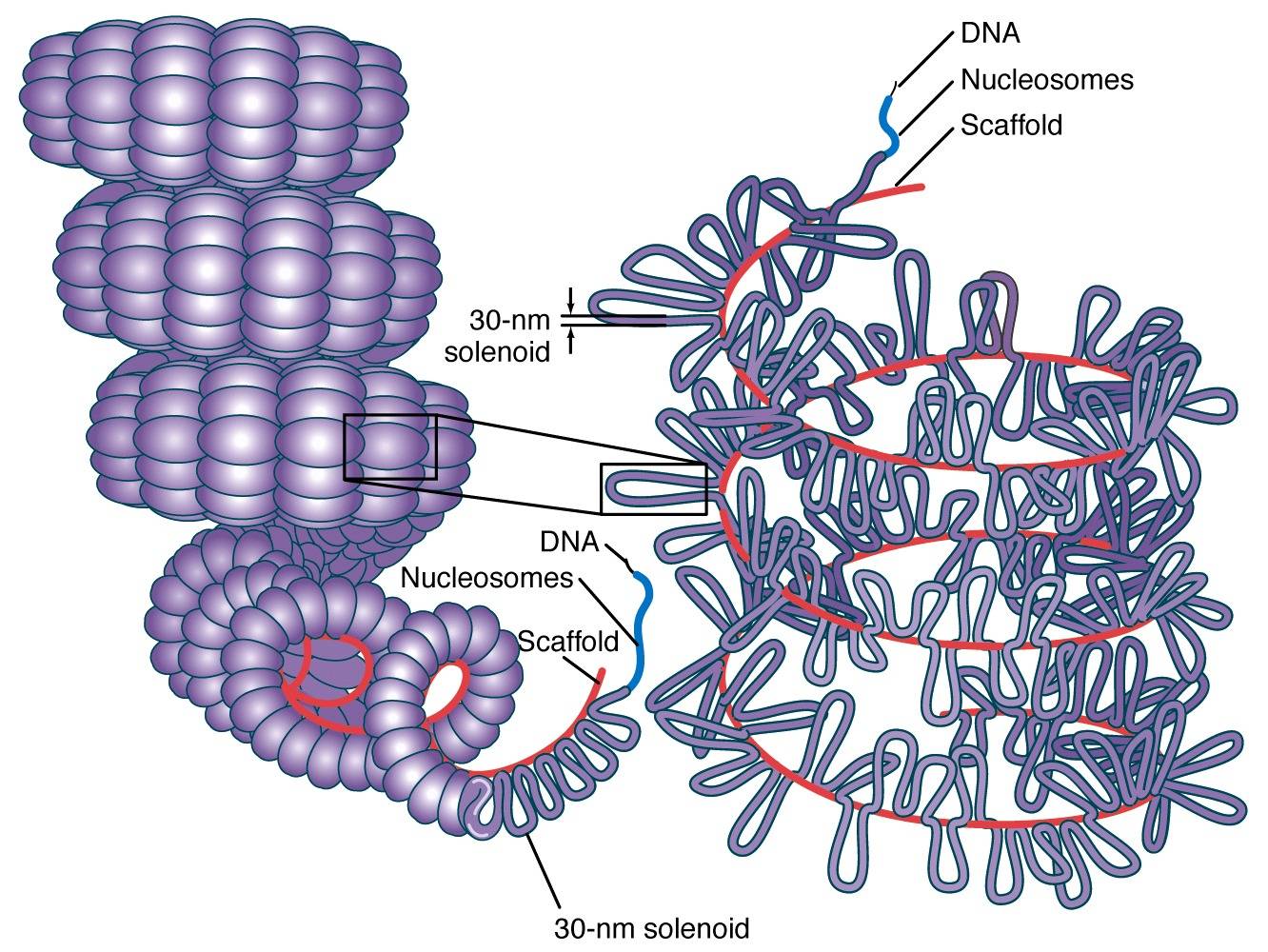
  • The beads-on-string structure in chromatin is packaged to form chromatin fibres which then fold together into large looped domain.that are further coiled and condensed at metaphase stage of cell division to form chromosomes.
  • The packaging at higher level requires non-histone proteins. 

HETEROCHROMATIN AND EUCHROMATIN:

In a typical nucleus, some region of chromatin are loosely packed (and stains light) and are referred to as euchromatin.Euchromatin is said to be transcriptionally active
The chromatin that is more densely packed and stains dark is called as heterochromatin. Heterochromatin is transcriptionally inactive.


NERVE IMPULSE


Neurons send messages electrochemically i.e chemicals(ions) cause an electric impulse.Neurons and muscle cells are electrically excitable and can transmit electrical nerve impulses.

SODIUM-POTASSIUM PUMP & ION CHANNELS:

A transport protein embedded in the cell membrane acts as "Sodium/potassium/ATPase".
It works to release the Na+ ions outside and K+ ions inside using ATP.

To check the function of Sodium-Potassium pump,there are also Na+ K+ ion channels in the membrane which when closed still leak allowing sodium inside and potassium outside down their concentration gradient.


THE RESTING MEMBRANE POTENTIAL:

The combination of Sodium Potassium pump and ion channels causes a stable imbalance of ions across the membrane.This imbalance of ions creates a potential difference between the inside of the neuronal membrane and its surroundings called the RESTING MEMBRANE POTENTIAL.

It is always negative inside the cell membrane and positive outside due to the presence of -vely charged proteins and +vely charged Na+ respectively.
In humans it is -70 mV.


ACTION POTENTIAL:

"WHEN A STIMULUS IS APPLIED, A BRIEF REVERSAL OF THE MEMBRANE POTENTIAL LASTING FOR ABOUT A MILLISECOND OCCURS.THIS IS CALLED THE ACTION POTENTIAL" 

ALL OR NOTHING LAW:

The action potential only occurs if the stimulus causes enough sodium ions to cross the membrane to change the membrane potential to a certain threshold (-30 mV) in humans.At this point Na+ rush inside.If depolarization is not strong enough to reach the threshold then no action potential is generated.

DEPOLARIZATION:

When stimulated past threshold,sodium channels open and Na+ ions rush inside creating a region of positive charge within.This is called depolarization.

The region of positive charge causes the nearby voltage gated sodium channels to close.

REPOLARIZATION:

Just after the Na+ channels close,the K+ channels open wide and K+ ions enter the cell bringing the charge across the membrane back to normal.This is called REPOLARIZATION.
                                                                                                                 
PROPAGATION OF IMPULSE:

The process continues as a chain reaction along the axon membrane.The influx of Na+ depolarizes and outflow of K+ repolarizes the membrane.

REFRACTORY PERIOD:

The time period within which the sodium and potassium are returned to their rightful places on either side of the membrane through the ATP pump is called refractory period.

While the neuron is in this period ,it doesn't respond to any stimulus.

SYNAPSE:

The region where the impulse moves from one neuron to another is called synapse.
It consists of :
PRE-SYNAPTIC MEMBRANE:The axon terminals.
POST-SYNAPTIC MEMBRANE:The dendrite of the other neuron or in some cases the cell membrane of the muscle,this synapse is called motor-end plate.

TRANSMISSION OF IMPULSE:
  • The pre-synaptic membrane,axon terminals contain many vesicles filled with neurotransmitters such as acetylcholine ,gab,serotonin,glycine ,nor-epinephrine etc.

  • As the impulse is propagated to the axon terminals,calcium channels present there open and allow diffusion of Ca++ ions from synaptic cleft to synaptic membrane.
  • This causes the vesicles to release the neurotransmitter into synaptic cleft.


  • The neurotransmitters bind to specific receptors on the post-synaptic membrane to generate action potential in the cell.
  • Neurotransmitters are then reabsorbed by the axon terminals.Ca++ ions move out.


Friday, 28 June 2013

COLORS OF THE SKY


The atmosphere around us contains dust particles,water droplets and gas molecules.the white light coming from the sun passes through most of the gas and water droplets but the gas molecules are way larger than the wavelengths of light ,thus these molecules absorb the low level wavelengths(mostly blue but also violets and green)and afterwards they radiate the same color light out.in this way the blue light gets absorbed and radiated making the overhead blue .the remaining colors the yellows and reds make up the color of the sunlight thus the sun appears yellow.


During sunset the light reaches us from over a larger distance(we are moving away from the sun) thus more of it (the blues) are scattered and the yellows and reds more visible.The most spectacular shows occur when the air contains many small particles of dust or water. These particles reflect light in all directions. Then, as some of the light heads towards you, different amounts of the shorter wavelength colors are scattered out. You see the longer wavelengths, and the sky appears red, pink or orange.


I Was Afraid of Rhett Butler

By Clark Gable

Liberty magazine, February 1940

THE LEGENDARY CAPTAIN RHETT BUTLER

Rhett Butler really put me on a spot, a hot one. Or rather Margaret Mitchell did when she created Rhett. I hope some day to have the privilege of meeting Miss Mitchell. This is partly curiosity. When a lady puts you on a spot it is only human to want to meet her. More than that, I feel we have a lot in common. Misery loves company. I can understand perfectly why she built a wall around her home. Haven’t I wanted to do the same thing during the past year? Rhett put us both on a spot. We are his innocent victims. I am certain I can speak for Miss Mitchell as well as for myself in saying that neither of us had any idea of the dent he was going to make in our lives.

Frankly I was one of the last few millions to read Gone with the Wind. When people first started talking about the book and Rhett, I wasn’t impressed. Everybody in Hollywood has the greatest story ever written. I am constantly asked to read novels, plays and originals that will make screen epics. Besides, I wasn’t interested in playing a character named “Red” Butler. It would mean dyeing my hair or wearing a wig and that’s too much to ask, even of art. Later I learned in a rather embarrassing discussion that it was Rhett, not “Red,” which punctured a good defense. What aroused my interest was a puzzling flood of letters, urging me to play Rhett, “because he was obviously written for me,” and those many friends who told me emphatically I was Rhett, and that fifty million Americans couldn’t be wrong. I read Gone with the Wind. My reaction was enthusiastic and immediate. “What a part for Ronald Colman,” I said. I was sincere.

Right here I would like to clear up a misunderstanding. The tremendous popularity of the book inspired many myths. One of these, frequently repeated, contends that Miss Mitchell had me in mind to play Rhett on the screen when she wrote her book. This is not true. She got her idea for the book and was writing it while I was a four-dollar-a-day laborer in the Oklahoma oil fields. I could have been an inspiration to no one, except possibly a soap salesman.

I cannot honestly say that I didn’t want to play Rhett, I did. But there certainly was a rub. Miss Mitchell hadn’t missed a thing. She left nothing to the imagination. Rhett was as real as life. That’s one of the things I have a desire to ask Miss Mitchell. Where did a quiet and gentle lady meet a man like Rhett Butler? Take it from me, there was a Rhett Butler and he wasn’t Clark Gable. In my travels I’ve known men like him. There was a gambler in Bigheart, Oklahoma, with long slender white fingers, who could deal faro like nobody else. He dressed and talked like a Virginia gentleman, killed a man one night, and every woman in town—but that’s another story.

Rhett was too popular, had fired the imaginations of too many people. Literally millions of people knew Rhett better than they knew George Washington. Everyone couldn’t be pleased, not even the majority. I knew that.

I might have saved myself my worrying. When the time came for the decision, I had little to do about it. David O. Selznick had purchased the screen rights and Dave was interested in making a separate deal with me, providing my studio would give me time off to make the picture for him. It was with considerable pleasure that I informed David my contract with Metro-Goldwyn-Mayer was about as iron-clad as smart lawyers could make it. And as a minor additional point, I didn’t want the part for money, marbles or chalk.

David was fair, but firm. He wanted me to know that he was going to try for a deal with MGM anyhow. I could see myself being sold down the river.

 I didn’t ask the studio not to loan me. I said nothing. My contract states that I have no choice of roles. News that the deal had been agreed upon reached me during the making of Idiot’s Delight. I read it in the paper. The guillotine, I thought. I was farmed out for a percentage of the profits to Metro-Goldwyn-Mayer.

Then I lost my fear of Rhett. There were too many other things to think about. I started out with the idea of knowing Rhett as well as I know myself. I lived with him day after day, reading and rereading Gone with the Wind, underlining each sentence that revealed a facet of his many-sided character. Making the picture was comparatively easy and a pleasure. The hard work was during months of unrelenting preparation.I felt that it was essential to have Rhett so minutely pegged in my mind that it would not be necessary to think consciously about him, a direct person, extremely confident, sure of himself in any situation. A man of unrelenting will, unchangeable once he had made up his mind, polished, a gentleman, yet his own worst enemy, a mellow blending of good and bad, with a saving sense of humor.

I had no difficulty visualizing Miss Leigh as Scarlett. My thanks here are publicly expressed to Miss Leigh for making it a pleasure to believe the part of Rhett.

Scenes were not filmed in sequence, since this is not practical because of technical problems, but the book was religiously followed in its essentials. If a favorite scene is missing, you can blame the restrictions of censorship. Tut, tut, Miss Mitchell. Some dialogue and certain situations were thus eliminated but ninety per cent of the dialogue used was taken directly from the book.

Rhett always will remain among the most memorable roles I have played on the screen, although I sincerely believe that Fletcher Christian in Mutiny on the Bounty was a part of equal caliber. It was the unprecedented public interest in Rhett that made him a difficult and frightening role to tackle. Gone with the Wind belongs to the public, not Hollywood. Anyhow I’m glad it’s over. Now I can get a haircut. And I’ve got my fingers crossed.

A YOUNGER PICTURE WITH THE HAIR NOT-SO-SLICKED BACK IN THAT HORRID STYLE.


FROM THE ARCHIVES OF http://dearmrgable.com/

Entertainment TODAY

Is it ok to watch or listen to whatever they put out there today?  I'm tired of it, the music is all about sex, and it is all blunt, without even trying to be subtle.  TV just wants everyone to feel ok about all perversions.  Every show has a gay or lesbian couple, unwed teenage mothers, and allusions to inappropriate material with some kind of authority laughing like it is ok (i.e.  teenage sexual references with a parent just laughing like "kids these days ha ha...").

I'm so tired of it all.  It's not ok to glorify homosexuality, promiscuity, or drug and alcohol abuse.  Everyone wants to sit there and say, "things are bad today" or "things aren't like they used to be...", but everyone wants to sit down and watch these tv shows that are nothing but garbage.  Everyone likes two and half men, they let their kids watch it, but they wonder why our teachers are having relations with our kids, or why our kids dress/act the way they do.  It's because anything goes today, and whats worse is that some people don't even bat an eye at it.

I despise our culture today, I once completely enjoyed the clever euphemisms or zany actions that made no sense, but now I wish everyone would grow up.

Wonder why our leadership is so horrible????  It's because everyone is looking out for themselves, watching the things that are funny or make them feel good, not trying to maintain the sanctity of innocence.

News reporters, film and music executives, our government, Steve Jobs, Bill Gates, the founders of YouTube, myspace, Facebook, etc.... are all TERRORISTS.  Why you ask.....  because they have successfully distracted the entire American public enough to allow those with political/monetary agendas to have their way with us.

Don't believe me.  If we are in such a recession, why did Black Friday revenue exceed last year by 1 Billion dollars?  That's 1000 million dollars.  Do people really not have money, or are the so called 1% manipulating everything so that they can get their way?  Why did oil companies make record profits after 9/11 and the economic stress that it put on our country.  Was it a set up?  I pray that it wasn't.

I know that some companies are failing, but I wonder why.  Instead of due diligence, they do what feels good, because everyone should pursue their dreams at all costs, even if it means that their dreams fail. They fail because they took their profit and went to the Bahamas, or invested in some new dot com start up that allows you to put your favorite books online so that others can see what you read in case they like to read, blah, or bought a new Mercedes because that was their dream since they were a kid.  This instead of reinvesting into the company, making good decisions, and reaping the benefits later.  No, we want it all now, (just like the commercials make you feel it is ok to do).

Please don't believe that I haven't been guilty of these things as well.  I watch crappy shows still, though I try to stop myself.  Ive looked at stuff online that I'm not proud of, and made purchases when I really shouldn't have.  I am guilty too, but when will it be too much.  Ever? I'm going to step up and try to live what I write, but I doubt anyone else will step up, because that will infringe on someone else's right to BLAH BLAH BLAH.

Friday, 21 June 2013

HORMONAL CONTROL OF FEMALE REPRODUCTIVE CYCLE

Estrogen continues being produced throughout childhood.It is this that inhibits the production of gonadotropin releasing hormone until hypothalamatic changes override the oestrogen signals.

  • MENSTRUAL PHASE:  (DAY 1-5)

UTERINE CHANGES:
The shedding of the endometrium causes the blood vessels to rupture ,thereby starting the bleeding which marks the onset of the menstrual phase.

OVARIAN CHANGES:
At this stage ,follicles are developing in the ovaries from the aggregate of germinal epithelial cells of that organ.These follicles later house the egg cells.

  • FOLLICULAR PHASE:(DAY 6-12)

At the onset of puberty or just before it  the release of GNRH into the brain positively effects the anterior pituitary gland to commence the production and secretion of the human gonadotropins, LH and FSH.

OVARIAN CHANGES:
FUNCTION OF FSH :
Since the follicular cells are responsible for the output of estrogen, LH and FSH, in turn, promote maturation of follicle.A single primary oocyte is targeted to resume the halted stages of meiosis and develop into a mature follicle.
Maturation of the follicle means increased production of estrogen.
FUNCTION OF ESTROGEN:
This increase in estrogen serum levels exhibits a negative feedback on the anterior pituitary inhibiting the release, but stimulating the production and storage of the gonadotropins.

UTERINE CHANGES:
FUNCTION OF ESTROGEN:
Initiates thickening of uterine wall ,endometrium by formation of mucous and blood capillaries.

  • OVULATORY PHASE:(DAY 13-15)

The phase during which the egg cells rupture out from the follicles and enter the fallopian tube.

OVARIAN CHANGES
FUNCTION OF ESTROGEN:
With the cessation of gonadotropin output, estrogen levels continue to rise; and, while the initial small rise in estrogen inhibits gonadotropin release, high estrogen levels have the opposite effect. By the time the ovarian estrogen production reaches its maximum before day 14, the negative feedback effect on the anterior pituitary is reversed to a dramatically positive one and a burst-like surge of stored LH is released .
FUNCTION OF LUTEINIZING HORMONE:
The LH surge is actually responsible for affecting the final development, and subsequent rupture of the mature follicle
ESTROGEN INHIBITION :
The cells responsible for estrogen secretion -- are damaged by the rough contact with the ovary wall. Estrogen output is then halted and serum levels drop slowly for a short period immediately following the ovulatory process.

  • CORPUS LUTEAL PHASE:(DAY 16-28)

OVARIAN CHANGES:
FUNCTION OF LUTEINIZING HORMONE:
The extraordinarily high levels of LH now have another function.
Once the ovum and its remaining surrounding cells are swept into the fallopian tube, luteinizing hormone works to establish the corpus luteum from the remnants of the ruptured mature follicle inside the ovary.The remaining follicular cells then enlarge .Under the influence of LH, these enlarged cells become the corpus luteum.
FUNCTION OF PROGESTERONE AND ESTROGEN:
The corpus luteum is a gland which maintains the responsibility of both the production and secretion of estrogen and progesterone.
As estrogen and progesterone levels again rise, their combined effect on the anterior pituitary's production of the gonadotropins is extremely negative and LH levels decline significantly.
LUTEINIZING HORMONE INHIBITION:
Since it is LH that is responsible for the maintenance of the corpus luteum, the marked decline in LH levels  heralds the degeneration of the corpus luteum into a scar called the corpus albicans.
PROGESTERONE INHIBITION:
With the corpus luteum no longer producing progesterone and estrogen, the serum levels of the ovarian hormones decline sharply and the menstrual phase may then begin.

UTERINE CHANGES:
FUNCTION OF PROGESTERONE:
It makes the endometrium thicker and more blood vessel rich to ready it for the product of fertilization,if there is any.
Low levels initiates shedding of endometrium.

Thursday, 20 June 2013

ELECTROPHILIC SUBSTITUTION OF BENZENE
Benzene is an aromatic compound that shows exceptional but explainable behavior. Being a highly saturated compound,it ought to undergo addition reactions but instead undergoes substitution.
The reason for this is the conjugated system of pi bonds in benzene that is further explained in "Modern Concept Of Benzene".

Electrophilic substitution reactions involve an electron-poor species(atom ,ion or molecule)which maybe a positive ion or partial positive end of a polar molecule and is called the ELECTROPHILE and an electron-rich species.The electrophile replaces a hydrogen atom in the ring.

TYPES OF ELECTROPHILIC REACTIONS IN BENZENE ON THE BASIS OF ELECTROPHILE:

  • HALOGENATION:
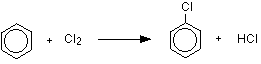
The process in which a ring hydrogen is replaced by a halogen in the presence of Lewis Acid catalyst is called halogenation.


The electrophillic reaction in which a halogen takes the place of a hydrogen atom in the ring in the 
presence of a Lewis acid catalyst.
CATALYST:
Iron reacts with some of the chlorine in the following manner:


REAGENT:
Taking CHLORINE as an example of a halogen,it is difficult to form a positive ion since that requires too much energy,hence it is merely polarized.

FORMATION OF ELECTROPHILE:
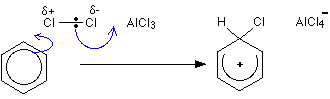
As the chlorine molecule approaches a benzene ring, the delocalised electrons in the ring repel the electrons in the chlorine-chlorine bond. That induces a dipole in the chlorine.


Also nearby is the FERRIC chloride, and this encourages the polarization of the chlorine.The FERRIC is strongly attracted to the slightly negative end of the chlorine molecule, and pulls electrons even more towards that end.

The Electrophilic substitution mechanism:

STAGE 1:
Formation of intermediate arenium ion:
Two electrons from the delocalization form a new bond with the partial positive end of the chlorine molecule.This breaks the delocalization partly and the ring attains a positive charge.It is now called arenium or benzene ion.


The breaking of the chlorine molecule transfers 1 atom to the benzene and one to the ferric chloride forming AlCl4

STAGE 2:
Formation of HCl and regeneration of catalyst:
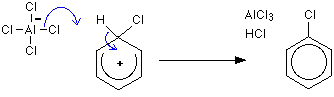
One of the aluminium-chlorine bonds breaks and both electrons from it are used to join to the hydrogen. Removing the hydrogen from the ring forms the HCl which is also produced in the reaction, and the ferric chloride catalyst is re-generated. The electrons which originally joined the hydrogen to the ring are now used to re-establish the delocalised system.(3)

  • SULPHONATION:
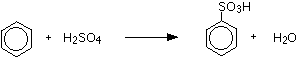
The process in which a sulphonic acid group replaces a ring hydrogen atom.


The formation of the electrophile:
The electrophile is sulphur trioxide, and this arises in one of two ways depending on which sort of acid you are using.
1-DISSOCIATION OF SULPHURIC ACID:
Due to dissociation of concentrated Sulphuric acid ,it contains traces of SO3.(1)


2-FUMING SULPHURIC ACID:
It is a solution of SO3 in H2SO4. Hence, contains more SO3.

Sulphur trioxide is highly polar with all the oxygen atoms pulling the electrons towards themselves leaving a partially positive sulphur atom which attacks the benzene.

The electrophilic substitution mechanism:

STAGE 1:
Formation of intermediate arenium ion:
Two electrons from the delocalization form a new bond with the partial positive end of the chlorine molecule.This breaks the delocalization partly and the ring attains a positive charge.It is now called arenium or benzene ion.


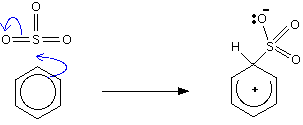
To make room for the new bond between the ring and benzene, two of the electrons joining the oxygen to the sulphur(in the double bond) are transferred entirely to the oxygen making it a negative ion.

STAGE 2:
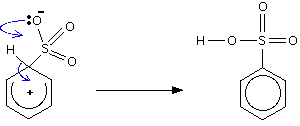
formation of Benzene Sulphonic acid:
The removal of hydrogen from the benzene ring is affected by the oxygen with the lone pairs.It forms a bond with the hydrogen and releases the electrons previously holding hydrogen into the ring to re-establish the delocalization. The benzene sulphonic acid is formed.


  • NITRATION:
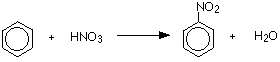
The process in which a nitro group replaces a hydrogen atom in benzene is called Electrophilic nitration.

Formation of electrophile:
NO2+!  or nitronium or nitryl cation is the electrophile.  It is formed by the reaction of sulphuric acid and nitric acid.


The electrophilic substitution mechanism:

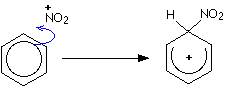
STAGE 1:
Formation of intermediate arenium ion:
As the nitronium ion approaches the benzene ring ,the delocalized electrons are attracted to the positive ion and two of them form a new bond with the nitronium ion thus breaking the delocalization.(2)


STAGE 2:

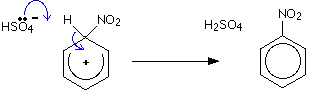
Formation of nitro benzene and Regeneration of catalyst:

The second stage involves the negative hydrogen sulphate ion, formed along with the nitronium ion.
The lone pairs of one of its oxygen atoms forms a bond with the hydrogen of the ring thus regenerating the catalyst by forming sulphuric acid and at the same time releasing the bonding electrons of hydrogen to re-establish the delocalization.


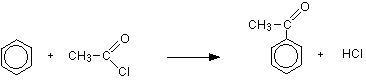
  • FRIEDEL-CRAFTS ACYLATION OF BENZENE:
The reaction in which hydrogen of the benzene ring is replaced by an acyl group.


FORMATION OF ELECTROPHILE:
The electrophile is CH3CO+.It is formed by reaction with catalyst aluminium chloride.(1)Alongside negative ion AlCl4-1 is also formed.


The electrophilic substitution mechanism:

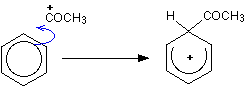
STAGE 1:Formation of intermediate arenium ion:

Two electrons from the delocalised system are used to form a new bond with the CH3CO+ ion affectively breaking part of the delocalization.(2)


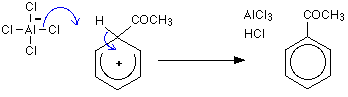
STAGE 2:
Formation of ketone and regeneration of catalyst:
The second stage involves the AlCl4 -1 formed alongside the positive ion.One of the aluminium chlorine bonds break and the chlorine with both electrons forms a bond with hydrogen from the ring.This results in the formation of phenyl ethanone and regeneration of AlCl3 catalyst.


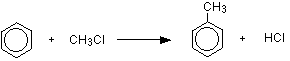
  • FRIEDEL-CRAFTS Alkylation OF BENZENE
The reaction involving replacement of a hydrogen of the benzene ring with an alkyl radical.

The formation of the electrophile:
The electrophile is CH3+. It is formed by reaction between the chloromethane and the aluminium chloride catalyst.


The electrophilic substitution mechanism:

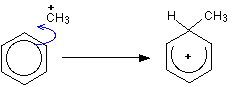
STAGE 1:
Formation of intermediate arenium ion:
Two electrons from the delocalized system are used to form a new bond with the ion CH3+.The delocalization is partly broken.Arenium ion is formed.(2)


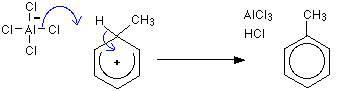
STAGE 2:
Formation of alkyl benzene and regeneration of catalyst:

The second stage involves the AlCl4 -1 formed alongside the positive ion.One of the aluminium chlorine bonds break and the chlorine with both electrons forms a bond with hydrogen from the ring.This results in the formation of methyl benzene and regeneration of AlCl3 catalyst.


oh LORD! the stories we spin...............