ELECTROPHILIC SUBSTITUTION OF BENZENE
Benzene is an aromatic compound that shows exceptional but explainable behavior. Being a highly saturated compound,it ought to undergo addition reactions but instead undergoes substitution.The reason for this is the conjugated system of pi bonds in benzene that is further explained in "Modern Concept Of Benzene".
Electrophilic substitution reactions involve an electron-poor species(atom ,ion or molecule)which maybe a positive ion or partial positive end of a polar molecule and is called the ELECTROPHILE and an electron-rich species.The electrophile replaces a hydrogen atom in the ring.
TYPES OF ELECTROPHILIC REACTIONS IN BENZENE ON THE BASIS OF ELECTROPHILE:
- HALOGENATION:
The process in which a ring hydrogen is replaced by a halogen in the presence of Lewis Acid catalyst is called halogenation.

The electrophillic reaction in which a halogen takes the place of a hydrogen atom in the ring in the
presence of a Lewis acid catalyst.
CATALYST:
Iron reacts with some of the chlorine in the following manner:
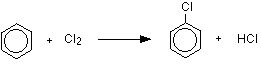

Taking CHLORINE as an example of a halogen,it is difficult to form a positive ion since that requires too much energy,hence it is merely polarized.
FORMATION OF ELECTROPHILE:
As the chlorine molecule approaches a benzene ring, the delocalised electrons in the ring repel the electrons in the chlorine-chlorine bond. That induces a dipole in the chlorine.
Also nearby is the FERRIC chloride, and this encourages the polarization of the chlorine.The FERRIC is strongly attracted to the slightly negative end of the chlorine molecule, and pulls electrons even more towards that end.
The Electrophilic substitution mechanism:
STAGE 1:
Formation of intermediate arenium ion:
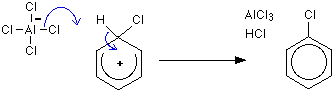
Two electrons from the delocalization form a new bond with the partial positive end of the chlorine molecule.This breaks the delocalization partly and the ring attains a positive charge.It is now called arenium or benzene ion.
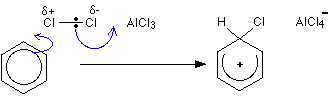
The breaking of the chlorine molecule transfers 1 atom to the benzene and one to the ferric chloride forming AlCl4
STAGE 2:
Formation of HCl and regeneration of catalyst:
One of the aluminium-chlorine bonds breaks and both electrons from it are used to join to the hydrogen. Removing the hydrogen from the ring forms the HCl which is also produced in the reaction, and the ferric chloride catalyst is re-generated. The electrons which originally joined the hydrogen to the ring are now used to re-establish the delocalised system.(3)
- SULPHONATION:
The process in which a sulphonic acid group replaces a ring hydrogen atom.
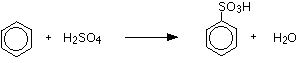
The formation of the electrophile:
The electrophile is sulphur trioxide, and this arises in one of two ways depending on which sort of acid you are using.
1-DISSOCIATION OF SULPHURIC ACID:
Due to dissociation of concentrated Sulphuric acid ,it contains traces of SO3.(1)

2-FUMING SULPHURIC ACID:
It is a solution of SO3 in H2SO4. Hence, contains more SO3.
Sulphur trioxide is highly polar with all the oxygen atoms pulling the electrons towards themselves leaving a partially positive sulphur atom which attacks the benzene.
The electrophilic substitution mechanism:
STAGE 1:
Formation of intermediate arenium ion:
Two electrons from the delocalization form a new bond with the partial positive end of the chlorine molecule.This breaks the delocalization partly and the ring attains a positive charge.It is now called arenium or benzene ion.
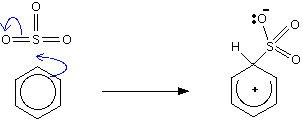
To make room for the new bond between the ring and benzene, two of the electrons joining the oxygen to the sulphur(in the double bond) are transferred entirely to the oxygen making it a negative ion.
STAGE 2:
formation of Benzene Sulphonic acid:
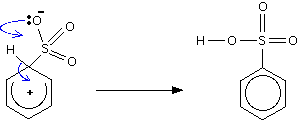
The removal of hydrogen from the benzene ring is affected by the oxygen with the lone pairs.It forms a bond with the hydrogen and releases the electrons previously holding hydrogen into the ring to re-establish the delocalization. The benzene sulphonic acid is formed.
- NITRATION:
The process in which a nitro group replaces a hydrogen atom in benzene is called Electrophilic nitration.
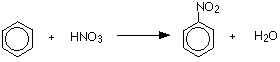
NO2+! or nitronium or nitryl cation is the electrophile. It is formed by the reaction of sulphuric acid and nitric acid.

The electrophilic substitution mechanism:
STAGE 1:
Formation of intermediate arenium ion:
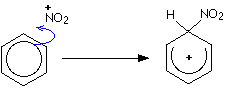
As the nitronium ion approaches the benzene ring ,the delocalized electrons are attracted to the positive ion and two of them form a new bond with the nitronium ion thus breaking the delocalization.(2)
STAGE 2:
Formation of nitro benzene and Regeneration of catalyst:
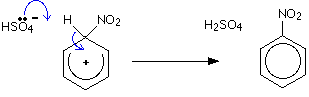
The second stage involves the negative hydrogen sulphate ion, formed along with the nitronium ion.The lone pairs of one of its oxygen atoms forms a bond with the hydrogen of the ring thus regenerating the catalyst by forming sulphuric acid and at the same time releasing the bonding electrons of hydrogen to re-establish the delocalization.
- FRIEDEL-CRAFTS ACYLATION OF BENZENE:
The reaction in which hydrogen of the benzene ring is replaced by an acyl group.
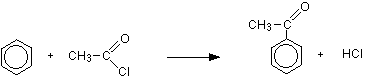
FORMATION OF ELECTROPHILE:
The electrophile is CH3CO+.It is formed by reaction with catalyst aluminium chloride.(1)Alongside negative ion AlCl4-1 is also formed.

The electrophilic substitution mechanism:
STAGE 1:Formation of intermediate arenium ion:
Two electrons from the delocalised system are used to form a new bond with the CH3CO+ ion affectively breaking part of the delocalization.(2)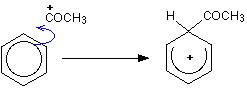
STAGE 2:
Formation of ketone and regeneration of catalyst:
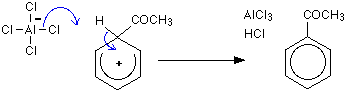
The second stage involves the AlCl4 -1 formed alongside the positive ion.One of the aluminium chlorine bonds break and the chlorine with both electrons forms a bond with hydrogen from the ring.This results in the formation of phenyl ethanone and regeneration of AlCl3 catalyst.
- FRIEDEL-CRAFTS Alkylation OF BENZENE
The reaction involving replacement of a hydrogen of the benzene ring with an alkyl radical.

The formation of the electrophile: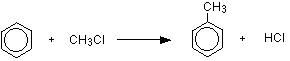
The electrophile is CH3+. It is formed by reaction between the chloromethane and the aluminium chloride catalyst.

The electrophilic substitution mechanism:
STAGE 1:
Formation of intermediate arenium ion:
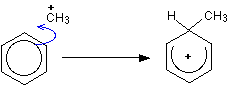
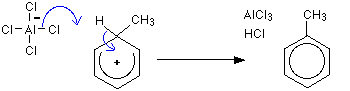
Two electrons from the delocalized system are used to form a new bond with the ion CH3+.The delocalization is partly broken.Arenium ion is formed.(2)
STAGE 2:
Formation of alkyl benzene and regeneration of catalyst:
The second stage involves the AlCl4 -1 formed alongside the positive ion.One of the aluminium chlorine bonds break and the chlorine with both electrons forms a bond with hydrogen from the ring.This results in the formation of methyl benzene and regeneration of AlCl3 catalyst.
oh LORD! the stories we spin...............