Showing posts with label PHYSICS. Show all posts

Sunday, 9 June 2013

LASER


LASERS--NO LONGER RESTRICTED TO CRIME-THRILLERS


A laser is a device that emits light (electromagnetic radiation) through a process of optical amplification based on the stimulated emission of photons.
The term "laser" originated as an acronym for "Light Amplification by Stimulated Emission of Radiation".
The emitted laser light is notable for its high degree of spatial and temporal coherence.

CHARACTERISTICS OF LASER LIGHT:
Laser light is very different from normal light.

  • The light released is monochromatic.
  •  It contains one specific wavelength of light (one specific color).
  •  The light released is coherent. It is “organized” -- each photon moves in step with the others.
  •  The light is very directional. A laser light has a very tight beam and is very strong and concentrated.

BOHR'S ATOMIC THEORY:


  • When an electron absorbs energy either from light (photons) or heat (phonons), it receives that incident quantum of energy. But transitions are only allowed in between discrete energy levels such as the two shown above. This leads to emission lines and absorption lines.


  • When an electron is excited from a lower to a higher energy level, it will not stay that way forever. An electron in an excited state may decay to a lower energy state which is not occupied, according to a particular time constant characterizing that transition. 
When such an electron decays without external influence, emitting a photon, that is called "spontaneous emission".


  • These excited state electrons can return to their resting state by emitting energy in the form of photons.The photon emitted has a very specific wavelength (color) that depends on the state of the electron's energy when the photon is released. Two identical atoms with electrons in identical states will release photons with identical wavelengths.


Working of a laser:
In order to produce the light rays associated with a laser thrre principles must be followed in the following order.

METASTABILITY:


STATE 1 IS METASTABLE  WHILE STATE 3 IS THE MOST STABLE

 Upon receiving certain quanta of energy ,electrons transit to another energy state (say E1 to E3).Since the stability of E3 is of the order 10ex-8 sec hence the electron soon decays to a lower energy level (say E2).However E2 is a metastable state since its life time is of the order 30ex-3 sec.

POPULATION INVERSION:


A number of problems limit the effectiveness of this approach. The central problem occurs because the lower laser level is the ground level, which is the normal state for most atoms or molecules. In order to produce the population inversion, a majority of ground state electrons must be promoted to the highly excited energy level, requiring a significant input of external energy. In addition, the population inversion is difficult to sustain for an appreciable time, and therefore, three-level lasers must be operated in pulsed mode rather than continuously.

As a result of metastability of E2 energy level,there are far more electrons in the E2 than in the E1 level.This is called population inversion as the rate of flow of electrons from E3 to E1 is greater than from E2 to E1.
This is achieved by very intense flashes of light or electrical discharges.

STIMULATED EMISSION:
Now that the electrons are in high energy levels the  stimulated emission must occur.In the process,an incoming photon stimulates an excited atom to give up its stored energy in the form of a photon that is identical in wavelength, direction, polarization, and phase to the stimulus photon.
If the excited atom is unable to produce a photon that matches the incoming photon, then stimulated emission cannot take place.
                                                                                         
As a photon passes through the collection of excited atoms, it can stimulate the generation of many trillions of photons, or more, creating an avalanche of light.

SUSTAINING STIMULATED EMISSION:
Two mirrors at either end of the lasing medium reflect these photons facilitating the light gain.The active medium can thus be regarded as an amplifier that takes in a small signal (one photon, say) and delivers a large signal (many photons, all identical to the first) at the output.


ASSEMBLY OF MIRRORS .ONE IS PARTIALLY AND THE OTHER FULLY SILVERED.
Monochromatic, single-phase, columnated light leaves the laser through the half-silvered mirror -- laser light!


PONT PHYSIQUE 

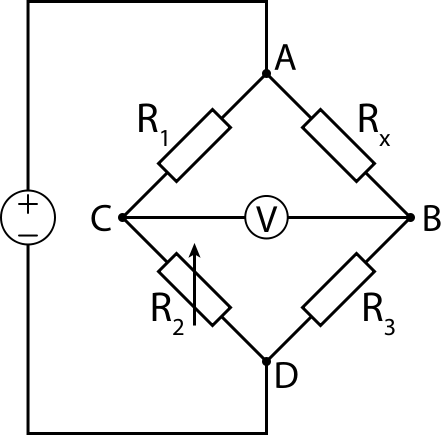
bridge circuit is a type of electrical circuit in which two circuit branches (usually in parallel with each other) are "bridged" by a third branch connected between the first two branches at some intermediate point along them

Wheatstone Bridge
The Wheatstone bridge is an electrical circuit for the precise comparison of resistances.It was invented by Samuel Hunter Christie in 1833 and improved and popularized by Sir Charles Wheatstone

CONSTRUCTION:


The Wheatstone bridge is an electrical bridge circuit used to measure resistance. It consists of

  1. a common source of electrical current (such as a battery) 
  2. a galvanometer that connects two parallel branches, containing four resistors,of which two are known R_1and R_3.One of the parallel branches contains one adjustable resistor R_2 and an unknown R_X.

 WORKING:

BALANCING THE BRIDGE:


If the bridge is unbalanced, the direction of the current indicates whether R_2 is too high or too low. R_2 is varied until there is no current through the galvanometer, which then reads zero.

If the ratio of the two resistances in the known leg (R_2 / R_1) is equal to the ratio of the two in the unknown leg (R_x / R_3), then the voltage between the two midpoints (B and D) will be zero and no current will flow through the galvanometer V_g.Such a bridge is called BALANCED.

Detecting zero current with a galvanometer can be done to extremely high accuracy. Therefore, if R_1, R_2 and R_3 are known to high precision, then R_x can be measured to high precision. Very small changes in R_x disrupt the balance and are readily detected.

At the point of balance, the ratio of R1 to R2 is equal to R3 and R4.

METER BRIDGE
It consists of a meter long wire of high resistance and low temperature co-efficient.

CONSTRUCTION:


  • It consists of a wire AB of 1 meter length and uniform cross section.
  • A battery of emf ' e ' , a plug key 'K' are connected between the two terminals A and B.
  • A graduated meter scale S is fixed by the side of the wire for taking the lengths of the wire from the +ve terminal i.e A. 
  • Three strips C1 ,C2 ,C3 of copper or bronze with negligible resistances are also stretched on the board with gaps in between them. 

  • A resistance box 'RB' is connected in the gap 'G1' . Resistance in RB = P 
  • The unknown resistance 'X' is connected in gap 'G2' .
  • In between the centre C of strip C2 , a galvanometer G and a high resistance 'H.R' are connected in series . 

The other end of the galvanometer is connected to a ‘jockey’ which is essentially a metallic rod whose one end has a knife-edge which can slide over the wire to make electrical connection.


  • When the jockey is at a point 'D' on the wire , it divides the wire into two parts AD and DB of lengths L1 and L2.
  • Resistance of AD length of wire =R = L1 [sigma] 
  • Resistance of DB length of wire = S = L2 [sigma]  

where [sigma] is the resistance per unit length of the wire.

Now , the circuit is exactly similar to a Wheatstone bridge.

WORKING:

The jockey is now pressed at various points one the wire from 'A' to towards 'B' , until we get near null deflection in the galvanometer . 

At this stage , the high resistance is shunted and the exact balance point giving null deflection at D is obtained . 

CALCULATIONS:

The length l1 from A to D is noted . The unknown resistance X can be calculated from the following equation.
When the bridge is balanced , we have

     [(P)/(X)]   =  [(R)/(S)]   =  [(l1)/(l2)]

But in a meter bridge l2 = ( 100 - l1 ) . So the balanced condition of a meter bridge is

[(P)/(X)]   =  [(l1)/(100-l1)]

USES:

The meter bridge can be conveniently used to

  •  determine an unknown resistance
  •     compare two resistance
  •     determine the specific resistance of the material of a wire . 


Thursday, 6 June 2013

X-RAYS
X-rays are generated when free electrons give up some of their energy when they interact with the orbital electrons (k-shell)or nucleus of an atom (Brehmsstrahlung).

REQUIREMENTS FOR PRODUCTION:

To generate X-rays, we must have three things. We need to have a source of electrons, a means of accelerating the electrons at high speeds, and a target material to receive the impact of the electrons and interact with them.
So what elements emit X-ray lines?
The more protons an element has, more energetic its lines can be. Carbon atoms (6 protons each) can emit X rays. But carbon lines are at the low end of X rays. Many X-ray instruments cannot detect these photons. Of the common elements in the universe, iron (26 protons) and oxygen (8 protons) usually are the two most prominent sources of X-ray lines along with tungsten and copper.

X-RAY PRODUCTION:


Bremsstrahlung X-rays


In an X-ray tube the electrons emitted from the cathode are accelerated towards the metal target anode by an accelerating voltage of typically 50 kV.

In the Bremsstrahlung process, a high speed electron traveling in a material is slowed or completely stopped by the forces of any atom it encounters.

If the electron is slowed down, it will exit the material with lesser energy.( The law of conservation of energy tells us that this energy cannot be lost and must be absorbed by the atom or converted to another form of energy). The energy used to slow the electron is excessive to the atom and the energy will be radiated as x-radiation of equal energy.

If the electron is completely stopped by the strong positive force of the nucleus, the radiated x-ray energy will have an energy equal to the total kinetic energy of the electron. This type of action occurs with very large and heavy nuclei materials.

K-SHELL EMISSION

The K-shell is the lowest energy state of an atom. An incoming electron can give a K-shell electron enough energy to knock it out of its energy state. About 0.1% of the electrons produce K-shell vacancies; most produce heat. Then, a tungsten electron of higher energy (from an outer shell) can fall into the K-shell. The energy lost by the falling electron shows up in an emitted x-ray photon. Meanwhile, higher energy electrons fall into the vacated energy state in the outer shell, and so on.

When outer-shell electrons drop into inner shells, they emit a quantized photon "characteristic" of the element. The energies of the characteristic X-rays produced are only very weakly dependent on the chemical structure in which the atom is bound, indicating that the non-bonding shells of atoms are the X-ray source.


K-shell emission produces higher-intensity x-rays than Bremsstrahlung, and the x-ray photon comes out at a single wavelength.

The X-ray photons produced by electrons that move from higher energy levels to k-shells, form the
K-SERIES.
If the electron moves from L-SHELL to K-SHELL,it gives rise to the first line of the K-SERIES which is "kα".
If the electron moves from M-SHELL to K-SHELL,it gives rise to the second line of the K-SERIES which is "kβ".
If the electron moves from N-SHELL to K-SHELL,it gives rise to the third line of the K-SERIES which is "kγ".
Similarly X-ray photons produced by movement of electrons from higher energy levels to L-shells constitute the L-SERIES and those into M-shells make up the M-SERIES.