Thursday, 6 June 2013

X-RAYS
X-rays are generated when free electrons give up some of their energy when they interact with the orbital electrons (k-shell)or nucleus of an atom (Brehmsstrahlung).

REQUIREMENTS FOR PRODUCTION:

To generate X-rays, we must have three things. We need to have a source of electrons, a means of accelerating the electrons at high speeds, and a target material to receive the impact of the electrons and interact with them.
So what elements emit X-ray lines?
The more protons an element has, more energetic its lines can be. Carbon atoms (6 protons each) can emit X rays. But carbon lines are at the low end of X rays. Many X-ray instruments cannot detect these photons. Of the common elements in the universe, iron (26 protons) and oxygen (8 protons) usually are the two most prominent sources of X-ray lines along with tungsten and copper.

X-RAY PRODUCTION:


Bremsstrahlung X-rays


In an X-ray tube the electrons emitted from the cathode are accelerated towards the metal target anode by an accelerating voltage of typically 50 kV.

In the Bremsstrahlung process, a high speed electron traveling in a material is slowed or completely stopped by the forces of any atom it encounters.

If the electron is slowed down, it will exit the material with lesser energy.( The law of conservation of energy tells us that this energy cannot be lost and must be absorbed by the atom or converted to another form of energy). The energy used to slow the electron is excessive to the atom and the energy will be radiated as x-radiation of equal energy.

If the electron is completely stopped by the strong positive force of the nucleus, the radiated x-ray energy will have an energy equal to the total kinetic energy of the electron. This type of action occurs with very large and heavy nuclei materials.

K-SHELL EMISSION

The K-shell is the lowest energy state of an atom. An incoming electron can give a K-shell electron enough energy to knock it out of its energy state. About 0.1% of the electrons produce K-shell vacancies; most produce heat. Then, a tungsten electron of higher energy (from an outer shell) can fall into the K-shell. The energy lost by the falling electron shows up in an emitted x-ray photon. Meanwhile, higher energy electrons fall into the vacated energy state in the outer shell, and so on.

When outer-shell electrons drop into inner shells, they emit a quantized photon "characteristic" of the element. The energies of the characteristic X-rays produced are only very weakly dependent on the chemical structure in which the atom is bound, indicating that the non-bonding shells of atoms are the X-ray source.


K-shell emission produces higher-intensity x-rays than Bremsstrahlung, and the x-ray photon comes out at a single wavelength.

The X-ray photons produced by electrons that move from higher energy levels to k-shells, form the
K-SERIES.
If the electron moves from L-SHELL to K-SHELL,it gives rise to the first line of the K-SERIES which is "kα".
If the electron moves from M-SHELL to K-SHELL,it gives rise to the second line of the K-SERIES which is "kβ".
If the electron moves from N-SHELL to K-SHELL,it gives rise to the third line of the K-SERIES which is "kγ".
Similarly X-ray photons produced by movement of electrons from higher energy levels to L-shells constitute the L-SERIES and those into M-shells make up the M-SERIES.



Wednesday, 5 June 2013

DISTINGUISHING TESTS

FOR ALKENE AND ALKANE:

Bayer's Test:

It is a quantitative test for the presence of unsaturation (double or triple bonds).
a sample is treated with small amount of elemental bromine either
  • as aqueous solution
  • as a solution in CCl4
  • as solution in CH2Cl2
REACTION:
Deep brown colouration of bromine rapidly disappears as it is consumed by reaction with sample containing alkenes.

Potassium permanganate test:

It is the quantitative test for the presence of unsaturation.
Dilute KMnO4 is purple and the test depends on its ability to act as an oxidizing agent.

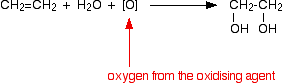
REACTION:
When alkenes are oxidized with cold, alkaline KMnO4, dihydroxy compounds (diols or glycols) are formed. The KMnO4 gets decolorized and in its place brown ppt of MnO2 is seen.


A more compressed form in which to express the reaction in is:

ALKANE AND ALKYNE:

Potassium permanganate test:

At room temperature:
Alkynes react with KMnO4 to give "dioics" and decolorize the purple hue of  the oxidizing agent.


At low temperature:
Alkynes may react to give an 'oic' at low temperatures.

ALKENE AND ALKYNE:

The formation of acetylides is used as mark of identification of alkynes.
ACETYLIDES are the dianions with the formula C2−2.They are formed by deprotonation of alkynes and subsequent addition of metals to the carbon atom.

Alkenes do not react as such with metals.

                                                                                         DI SODIUM ACETYLIDE


The above forms DISILVER ACETYLIDE which cools to form a white solid and DICOPPER ACETYLIDE which cools to form a red solid.

ALKANE AND ALKYL HALIDES:

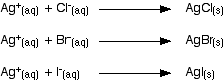
The most efficient way of distinguishing alkyl halides is by a substitution reaction which would convert the halogen into halide ions.The ions can then be tested by Silver Nitrate solution.


Haloalkanes are warmed with sodium hydroxide solution in a mixture of ethanol and water.Everything will    dissolve.


The nitric acid is added to remove other ions that give a confusing precipitate.
Silver Nitrate solution is added.
It may form white ,pale yellow or yellow ppt depending on the halogen.

ALDEHYDE AND KETONE:

Aldehydes are easily oxidized by all sorts of different oxidizing agents: Ketones aren't.
For Aldehydes ,Oxidation under :
Acidic conditions---gain of oxygen
Alkaline conditions---lose of hydrogen and gain of oxygen

Fehling's Test:
Fehling's solution contains copper (II) ions complexed with tartrate ions in sodium hydroxide solution.

Aldehydes reduce the complexed copper (II) ion to copper (I) oxide. 
Because the solution is alkaline, the aldehyde itself is oxidized to a salt of the corresponding carboxylic acid.


  • ketone         :No change in the colourless solution.  
  • Aldehyde     :Red ppt of Cu2O.

    Tollen's Test:

    Tollens' reagent contains the diamminesilver (I) ion, [Ag (NH3)2] +.

    Aldehydes reduce the diamminesilver(I) ion to metallic silver. 

    Because the solution is alkaline, the aldehyde itself is oxidised to a salt of the corresponding carboxylic acid.

    • ketone     : No change in the colourless solution.  
    • aldehyde  : The colourless solution produces a Grey precipitate of silver, or a silver mirror on the test tube.  


    Monday, 3 June 2013

    STRUCTURE OF DNA


    Watson and Crick Model of DNA
    James Watson and Francis Crick proposed a structure for the DNA molecule that suggested the basic mechanism of DNA replication.

    COMPONENTS OF DNA:
    DNA is composed of two chains of repeating nucleotides. Each nucleotide consists of three components. These components are:
    1.    Phosphate Group (H3PO4)
    2. Deoxyribose sugar (C5H10O4)
    3. A nitrogen containing base which may be:
    • cytosine
    • adenine
    • guanine
    • thymine

    STRUCTURE OF A DNA STRAND:

    The following are the features of the DNA molecule as described by Watson and Crick in 1953.
    The model proposes that DNA is composed of two complimentary strands of DNA running anti-parallel to each other.The two strands wrap around each other to form a double helix structure.

    5'---------------3'
    3'---------------5'

    The hydrophilic sugar(ribose) and phosphate groups of the nucleotides face the outside of the molecule (where water would be) and the relatively hydrophobic nitrogenous bases are on the inside of the molecule, hidden from water.
    The purine(adenine & guanine) bases are opposite to the pyrimidine(cytosine & thymine) bases.


    THE BONDS WITHIN THE DNA:
    • The nucleotides within each strand are held together by the phosphodiester bonds between the 5' carbon of one nucleotide and the 3 ' carbon of the adjacent nucleotide. These strong covalent bonds hold the sugar/phosphate backbone together.
    • The two strands of DNA are held together by weak hydrogen bonds between the nitrogenous bases.
    • Hydrogen bonds are base specific. That is, A (adenine) can only form 2 hydrogen bonds with T (thymine) and C (cytosine) can only form 3 bonds with G (guanine).

    ADVANTAGES OF THE STRUCTURE:
    • If one knows the sequence of bases of one strand, one can deduce the sequence in the complementary one. This property explains how a cell can replicate a DNA molecule to produce two identical molecule.


    • 'Chargraff's Rule' of DNA states that the amount of A in any DNA sample always equaled the amount of T and that the amount of G always equaled the amount of C. This structure proves it.

    CANCER

    Cancer, known medically as a malignant neoplasm, is a broad group of various diseases, all involving unregulated cell growth. In cancer, cells divide and grow uncontrollably, forming malignant tumors, and invade nearby parts of the body.

    TYPES OF TUMORS:

    BENIGN:

    Tumors that stay in one spot and demonstrate limited growth are generally considered to be benign.

    MALIGNANT:

    When a cancerous cell can perform metastasis using the blood or lymph systems and in the process makes new blood vessels to feed itself ,its called malignant.


    CANCER-A GENETIC DISORDER:

    At the molecular level, cancer is caused by mutation(s) in DNA, which result in aberrant cell proliferation.

    The mutation(s) occur in two classes of cellular genes:

    Proto-onco Gene:

    Normally causes high cell division rates where it is needed, such as in the fetus or in a wound. The abnormal activation of such a gene mostly due to single base substitution causes cancer.

    Tumor Suppressor Genes:

    Regulates suppression of proliferation thus,contribute to cancer by the inactivating of loss of function mutation mostly due to deletion.

    To read more about the treatment options ,patient care and research going on related to this deadly malady click on the following links:
    CANCER CARE SYSTEM IN USA - what needs improvement?
    HOPE SPRINGS ETERNAL...